Why Throwing Away Trash in Korea Feels Like Taking an Exam
Koreans rinse containers, peel labels and separate plastics with admirable discipline. Then they stare at a shampoo pump for thirty seconds and realize nobody actually knows what to do with it.
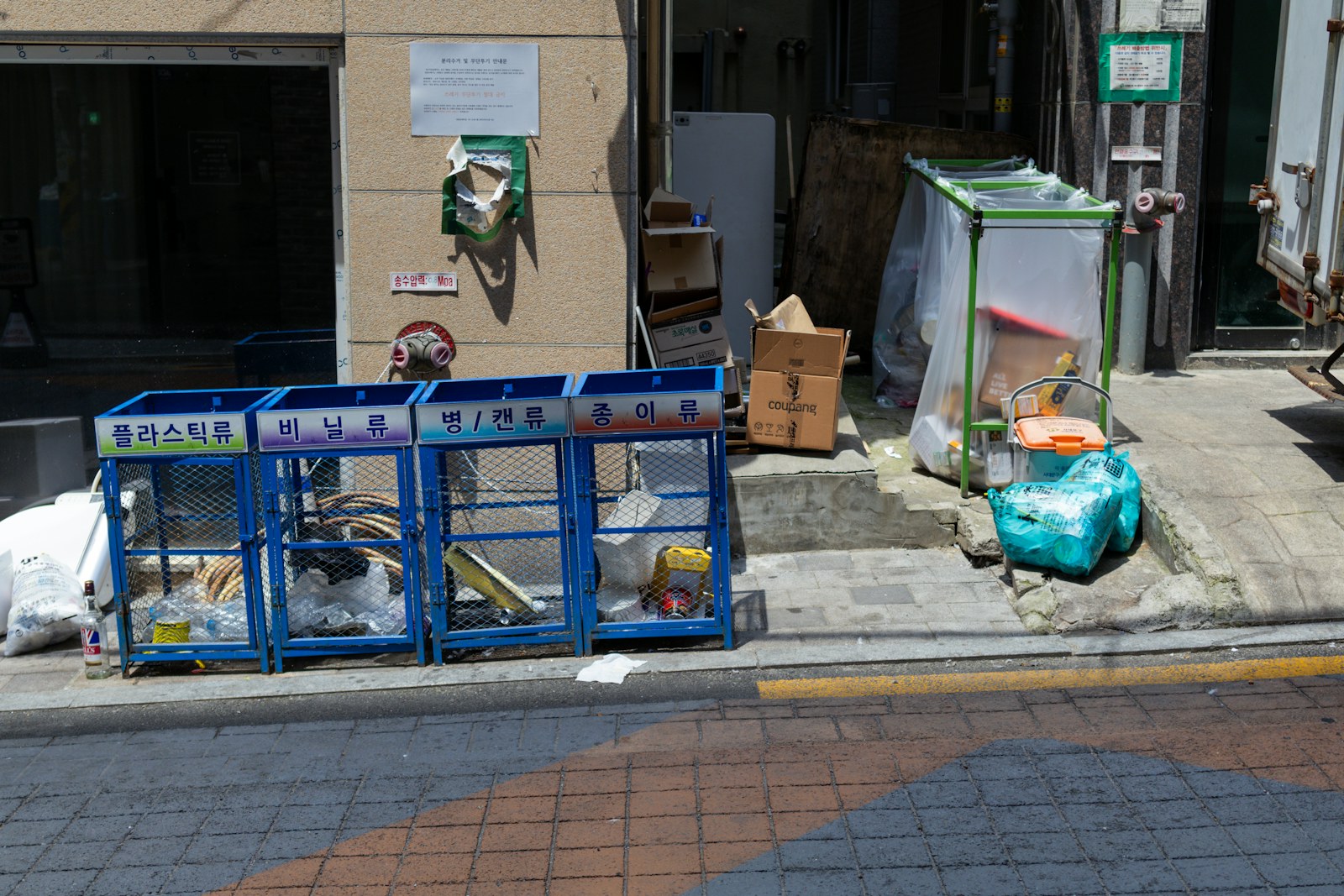
Stand in the recycling area of a Korean apartment complex and confidence can disappear very quickly.
A clear water bottle is easy enough. Remove the label. Crush the bottle. Separate it as clear PET. Fine.
Then comes a takeout container. Is it PET, PE or PP? Is the lid the same material? What about a black plastic tray? A cosmetic bottle with a spring-loaded pump? A coffee cup with a plastic lid and a paper sleeve? There may be five materials in your hand and three tiny recycling symbols printed in a font apparently designed for ants.
Koreans sometimes smile when foreigners complain that recycling rules are confusing. Then a Korean picks up an unfamiliar package, turns it upside down, squints at the triangle and joins the foreigner.
We are all students now.
Recycling in Korea is a household skill, not just a municipal service
Korea asks residents to do a surprising amount of pre-processing before waste leaves the building. Cardboard is flattened. Tape is removed. Food containers are rinsed. Clear PET bottles are separated. Food waste is collected separately, and many apartment complexes use RFID systems that weigh food waste and charge households accordingly.
Once it becomes a habit, much of this is not especially burdensome. In fact, visitors from countries with single-stream recycling can find the system impressively disciplined. Korea effectively turns millions of households into the first stage of the sorting plant.
This matters. Cleaner, better-separated waste is more valuable as a recycling feedstock. Clear beverage-grade PET, for example, can be recycled into higher-quality material if it is not mixed with colored plastics and contaminants.
But a system can be admirable and still ask the wrong person to do too much work.
One bottle can contain a small materials-science lecture
Plastic is not one thing. PET behaves differently from PE. PP is different again. Pumps can include metal springs. Labels use adhesives. Multi-layer packaging can combine materials that are difficult to separate. A product that was designed for thirty seconds of convenience may require the consumer to perform a small forensic investigation before disposal.
The more conscientious you are, the worse it gets. The careless person has an easy recycling system: throw it somewhere and walk away. The diligent person is standing under fluorescent lights at 10 p.m. Googling “Korean shampoo pump recycling.”
At some point this stops looking like environmental education and starts looking like unpaid quality control.
Germany has deposits. Japan has rules. America often has one bin. Korea somehow chose all of the homework
Different countries solve the same problem in very different ways. Germany is famous for deposit-return systems on many beverage containers. Japan’s municipalities can have meticulous sorting calendars and categories. Many American cities use single-stream recycling and push more of the sorting burden downstream at a materials recovery facility.
Korea’s approach sits somewhere between citizen discipline and industrial sorting. Consumers are told to separate carefully, while policy also pushes manufacturers toward easier-to-recycle labels, adhesives and packaging structures.
That second part deserves more attention.
If 50 million people are peeling labels, perhaps someone should redesign the label
Korean consumers are instructed to remove labels from clear PET bottles. But industrial policy also recognizes that labels can be designed to separate more easily during recycling. Different countries rely on different combinations of consumer removal and automated separation using differences in density, wash processes and material design.
This raises an awkward question: which is more effective?
Teaching tens of millions of people to perform one extra task every day, or requiring a few hundred manufacturers to design the package so the task becomes unnecessary?
The answer is not “one or the other.” Good source separation matters. Product design matters. Sorting technology matters. The point is that environmental responsibility is often narrated as a story about personal virtue because personal virtue is easy to photograph.
A person carrying a reusable cup is visible.
A chemical company changing an adhesive specification is not.
The second change may affect millions more containers.
Environmentalism loves giving consumers homework
Bring a tote bag. Refuse a straw. Wash the jar. Peel the label. Sort the cap. Carry a tumbler. Memorize the symbol.
None of this is useless. Collective behavior matters enormously. But the moral framing can become convenient for companies. A manufacturer sells a beautifully designed multi-material package. The consumer spends three minutes dismantling it. Then the package says, in cheerful green lettering, “Please recycle responsibly.”
There is a certain corporate elegance to this arrangement.
The company does the design.
You do the disassembly.
Everyone feels sustainable.
The best waste is not well-sorted waste
Recycling sits below a more basic idea: avoid creating the waste in the first place. Reduce, reuse, then recycle. Korea’s extraordinary delivery and e-commerce systems make this contradiction especially visible.
A late-night meal arrives in plastic bowls, lids, sauce cups, cutlery and a bag. Dawn grocery delivery arrives with boxes, liners and cold packs. Cosmetics arrive beautifully protected inside packaging designed to survive both logistics and Instagram.
Then, on recycling day, the consumer spends time dismantling the evidence.
A strong recycling system can accidentally make heavy packaging consumption feel morally painless. “It’s okay, I’ll recycle it” is a useful thought right up until the system is processing mountains of material that never needed to exist.
Technology may beat good manners
Modern sorting facilities can use cameras, near-infrared sensors, air jets, robotics and machine vision to identify materials at high speed. Packaging can be standardized. Labels can be designed to wash off. Pumps can be easier to disassemble. Recycled-content requirements can create demand for the material that consumers carefully sort.
These changes are less satisfying than peeling a label yourself because you cannot feel them happening. But environmental policy should not be a contest in how much inconvenience citizens are willing to endure.
A good system does not require heroic users.
It makes ordinary behavior produce good outcomes.
And then some of the plastic crosses a border
There is one more complication. Korea exports and imports plastic waste and scrap. World Bank WITS / UN Comtrade data show Korean exports in relevant plastic scrap categories to countries including Vietnam, Malaysia, Thailand and Bangladesh, while Korea also imports plastic scrap from abroad.
This does not automatically mean “Korea dumps its garbage on poorer countries.” That is a satisfying slogan and a bad analysis. Recyclable scrap is also an industrial commodity. Processing capacity, material quality and price differ by country. A shipment can genuinely be feedstock for a recycling plant.
But the trade does create a harder question: when does something count as recycled?
When your apartment sorts it?
When a truck collects it?
When a recycler buys it?
When it is exported?
Or only when it actually becomes a new usable material?
The answer matters because recycling statistics can look much better depending on where the accounting stops.
A rich country can be good at recycling — or good at moving waste
This is not a uniquely Korean problem. After China restricted many waste imports, global flows of plastic scrap shifted toward other Asian markets. Japan, the United States and European countries also appear among major exporters of plastic scrap. Waste has an international supply chain, just like oil, steel or semiconductors, except nobody puts it on the tourism brochure.
That means the recycling story does not end at the apartment bin. The bottle may have a passport.
And unlike the consumer, it may travel internationally without filling out a mobile-phone verification form.
The ideal recycling guide may be a very short one
Korea has built a valuable social habit: people expect to separate waste. That culture should not be dismissed. It is difficult to create and easy to lose.
But the next generation of environmental policy should probably ask fewer questions about how to make citizens memorize more categories and more questions about how to remove categories entirely.
Why does this package need three materials?
Why does this label need that adhesive?
Why can’t this pump be disassembled easily?
Why should millions of people perform the same tedious operation if a manufacturing standard could eliminate it?
The best smartphone is not the one with the thickest user manual. A good waste system should work the same way.
So the next time you stand in front of Korean recycling bins, holding a cosmetic bottle and wondering whether you need a chemistry degree, do not feel too guilty.
You may not be bad at recycling.
The package may simply be giving you too much homework.