
Olive Young Is Becoming the Stock Exchange of K-Beauty
SaSa once taught Asian travelers to shop across beauty brands in one place. Olive Young is doing something more ambitious: helping decide which Korean brands become visible enough to matter.
If you traveled through Hong Kong in the 2000s, there is a good chance you remember the pink sign.
SaSa.
There was one in Tsim Sha Tsui, another in Mong Kok, another in Causeway Bay. Inside were perfumes, Japanese skincare, French cosmetics, Korean masks, discount stickers and a level of product density that made department-store counters feel almost ceremonial.
SaSa broke down the walls between brands. Instead of walking into a Dior counter and speaking to Dior staff, shoppers could compare dozens of brands in one place. For tourists, that was especially powerful. Going to Hong Kong and going to SaSa became part of the same shopping itinerary.
For a long time, that looked like the future of Asian beauty retail.
Then Korea built something that looked similar from the outside and turned out to be structurally different.
Olive Young is not just where products are sold
A small Korean beauty brand can make an excellent serum, package it beautifully, hire influencers and build a polished website. None of that solves the first problem: nobody knows it exists.
Then the product gets into Olive Young.
Something changes.
A Korean shopper sees the unfamiliar bottle and thinks, “Oh, it’s in Olive Young.” That does not mean the product has been scientifically certified by the retailer. It means something more subtle: the brand has passed a commercial filter. Somebody selected it. Somebody gave it shelf space. It is now standing next to products the customer already knows.
The brand is borrowing a little of the retailer’s trust.
For young companies, that can be worth more than a thousand Instagram posts.
Retail shelves are not democratic institutions
Walk into a large beauty store and it feels like you are choosing freely from hundreds of products.
You are.
But somebody chose what you were allowed to choose from.
Who gets the front table? Who sits at eye level? Which brand enters the seasonal promotion? Which products receive award stickers? What appears on the app homepage? Which category gets expanded? Which launch receives an in-store campaign?
The consumer chooses at the end of a long series of choices already made by merchandisers.
This is why a strong retailer can influence not only what sells, but what becomes famous enough to sell elsewhere.
Google ranks webpages. Amazon ranks products. Apple decides which apps appear in the App Store. Olive Young does something similar in physical space, with moisturizers.
The numbers are getting hard to call “retail”
Olive Young opened its first store in Seoul in 1999. By the end of 2025 it had more than 1,380 stores in Korea, over ten million monthly active users and more than 17 million loyalty members. The scale makes it less like a specialist cosmetics chain and more like a national discovery engine for beauty.
The brands growing inside it are also getting larger. In 2025, 116 brands reportedly generated more than KRW 10 billion in annual sales through Olive Young, up from 36 in 2020. Several exceeded KRW 100 billion, and Mediheal passed KRW 200 billion.
Those are not Olive Young’s own sales figures. They are evidence of how large individual brands can become inside the platform.
At that point, “getting listed” starts to feel less like adding one retailer and more like entering a market.
SaSa and Olive Young represent two different eras
SaSa is important because it got there first in a different historical moment. Founded in 1978, it built a powerful multi-brand model around Hong Kong’s role as a shopping hub. Tourists came for imported beauty, price differences, trust in authentic products and the pleasure of comparing many brands at once.
Its great strength was aggregation: bring the world’s cosmetics to Asian shoppers.
Olive Young grew alongside the opposite flow. Korea became a major beauty producer. Domestic OEM and ODM manufacturing became sophisticated. Small brands could launch quickly. Social media shortened product cycles. Foreign visitors came to Korea specifically looking for K-beauty.
Olive Young did not merely aggregate products. It became part of the machinery that creates winners.
That is a more powerful position.
From “what sells” to “what will sell”
A product starts moving in Olive Young. The sales data become visible. Shelf space expands. Online exposure improves. It appears in campaigns and award lists. Consumers start posting it. Foreign tourists pick it up. Overseas buyers notice. More demand returns to the store.
Retail, marketing, review culture and export scouting begin feeding one another.
This loop is one reason K-beauty can move so fast. Korea has manufacturers capable of producing quickly, consumers willing to experiment, social media that broadcasts reactions immediately, and a huge physical network that can test products in the real world.
It is not a laboratory in the scientific sense.
It is something harsher: a market laboratory where the failed experiments remain on clearance shelves.
Then Sephora invited Olive Young inside
In 2026, the relationship became even more interesting. Sephora announced an “Olive Young K-Beauty Edit” in more than 500 U.S. stores, featuring Korean brands curated with Olive Young. Dedicated areas were also planned for other Asian markets.
Think about what this means for a small Korean brand.
Once, it might have tried to persuade a Sephora buyer directly.
Now it can succeed in Korea, become visible through Olive Young, be selected by Olive Young, and then enter Sephora as part of a curated Korean portfolio.
A retailer is recommending brands to another retailer.
Olive Young starts looking less like a shop and more like a rating agency for K-beauty.
This is why “getting into Olive Young” feels like half the battle
It is not literally half of success, of course. Plenty of products enter stores and disappear quietly. A shelf is not destiny.
But discoverability is one of the hardest problems in consumer products. A brand can survive mediocre awareness if nobody sees it? No. A brilliant formulation in an invisible bottle is still invisible.
Olive Young solves that problem at enormous scale.
And once foreign shoppers start treating the store itself as a destination, the listing carries a second benefit. It tells tourists, “This is part of the current Korean beauty landscape.”
That matters because most visitors do not have time to map Korea’s entire cosmetics industry. They see what the store shows them.
Which means the gatekeeper problem has arrived
The same system that helps brands can make them dependent.
What happens if a brand loses shelf space? If it is left out of a major promotion? If a competitor receives better placement? If discounts become expected? If shoppers remember “that thing I bought at Olive Young” more clearly than the brand itself?
This is the familiar platform problem. Amazon sellers know it. App developers know it. YouTube creators know it.
The gate gives you traffic.
The gate also reminds you that it owns the gate.
“Olive Young grows K-beauty” and “K-beauty is becoming dependent on Olive Young” can both be true at the same time.
The real question is who gets to define K-beauty
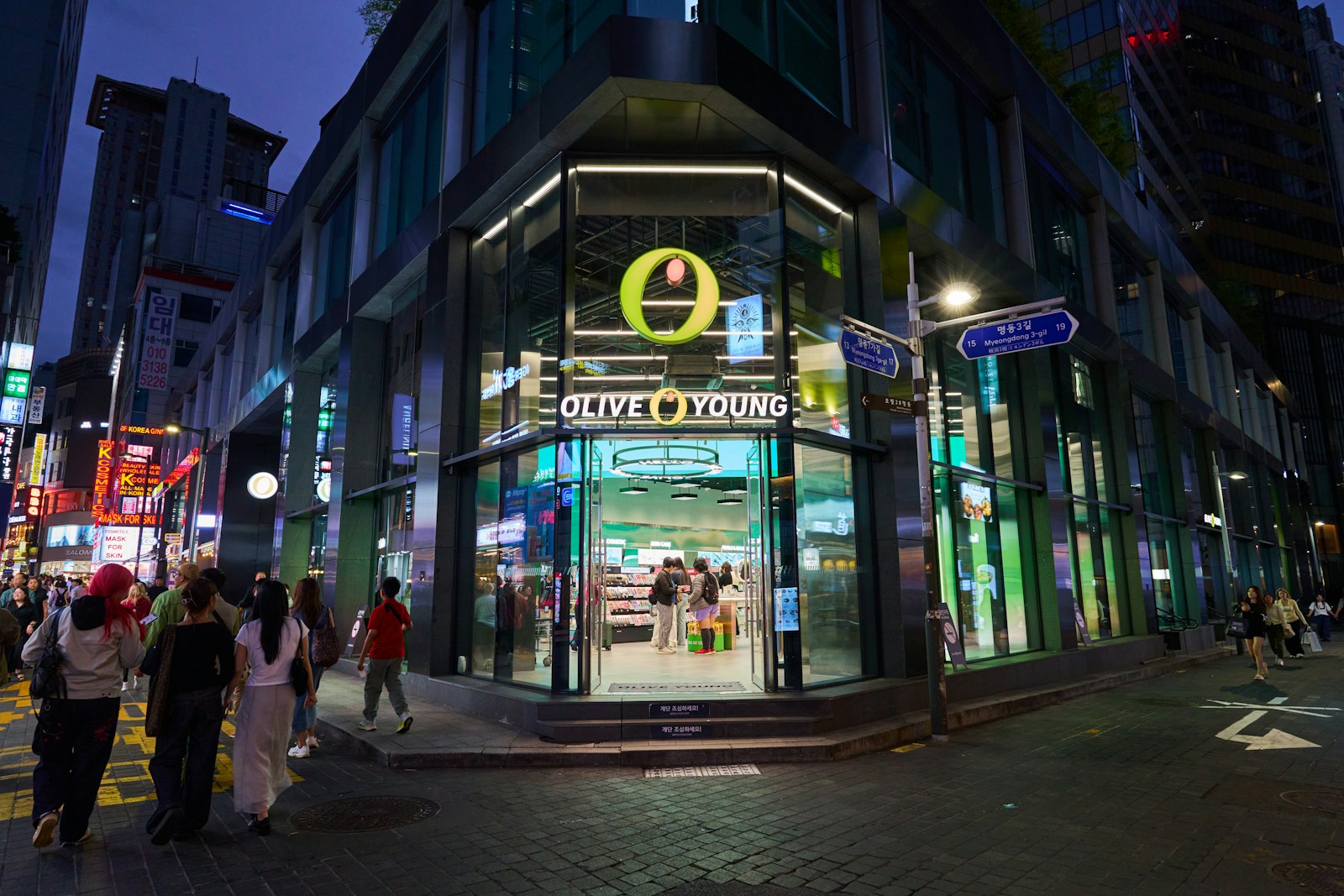
A tourist walks into Olive Young in Myeong-dong and sees a curated slice of Korean beauty. To that visitor, the slice can become the whole cake.
But Korea also has dermatologist brands, pharmacy cosmetics, direct-to-consumer labels, department-store lines and products that live mostly online. The industry is much larger than one retailer’s assortment.
Still, visibility changes reality. If millions of tourists, influencers and buyers repeatedly see the same group of brands, those brands become “K-beauty” in the international imagination.
That is why the stock-exchange analogy works.
Listing is not the end of the story. It is the beginning of public pricing.
Once you are on the exchange, the market starts voting every day.
And in beauty, an ordinary product that everyone can see can be far more dangerous than a brilliant product hidden where nobody looks.