Why Korea Has More Convenience Stores Per Person Than Japan
Japan perfected the modern konbini. Korea studied the model carefully, then somehow ended up with an even denser network — and a generation of retirees learning retail the expensive way.
A Korean office worker retires after thirty years.
There is a lump sum. There is no monthly salary. There is also a deeply unhelpful question: what now?
In Korea, this is where a familiar syllabus begins. Chicken shop? Cafe? Franchise restaurant? Convenience store?
The convenience store looks reassuring. The brand exists. The logistics system exists. Products arrive. The POS system works. Headquarters provides manuals. You do not need to be a chef. Nobody expects you to invent a croissant.
It looks like entrepreneurship with training wheels.
That is the first dangerous misunderstanding.
A convenience store may be easier to operate than an independent restaurant. That does not mean it is easy to make money from one.
Japan has the fame. Korea has the density
Internationally, convenience stores are strongly associated with Japan, and for good reason. Japanese konbini are masterpieces of logistics, food development and urban service design.
But by the end of 2025, Korea’s four major convenience-store chains had roughly 53,000 locations. Japan had about 56,000 major-chain convenience stores.
The populations are not close.
Japan has more than twice as many people.
So on a per-capita basis, Korea’s convenience-store network is roughly twice as dense.
There is a nice historical irony here. Korea learned a great deal from the Japanese model and then, like an overenthusiastic student, submitted extra homework.
A Korean convenience store is not really a small grocery store
A British corner shop sells essentials. A New York bodega may sell groceries, coffee and sandwiches. A Japanese konbini is famously multifunctional.
Korean convenience stores evolved in the same broad family but with their own urban logic. They sell lunch boxes, triangle kimbap, ramen, coffee, alcohol, snacks and household basics. Many handle parcel services. ATMs are common. Some locations have seating. Near parks and rivers they can function like cheap outdoor restaurants. In residential neighborhoods they become emergency pantries for people who do not want to walk ten minutes to a supermarket.
The product is not “groceries.”
The product is “whatever problem you discovered in the last fifteen minutes.”
No milk at 11 p.m.? Convenience store. Need batteries at 7 a.m.? Convenience store. Going hiking? Convenience store. Drunk and suddenly convinced you need cup noodles? Korea has planned for your crisis.
The store is also a retirement school
Korea’s unusually large self-employed sector matters here. A person who leaves salaried employment may struggle to find another job at a similar status or income. Starting a business becomes one of the few visible options.
Franchising reduces some uncertainty. The brand, supply chain and product system already exist. That makes a convenience store attractive to people with capital but limited retail experience.
Then the education begins.
You learn what foot traffic really means. You learn that 100 meters can be a huge distance. You learn about shrinkage, spoilage, cigarette margins, electricity bills, part-time labor, late-night staffing, weather, school calendars and the peculiar purchasing habits of people who buy exactly one boiled egg at 1:20 a.m.
You also learn the most important business lesson very quickly:
Sales are not your income.
Business schools charge tuition for this. A convenience store teaches it by withdrawing money directly from your account.
Why is there another convenience store across the street?
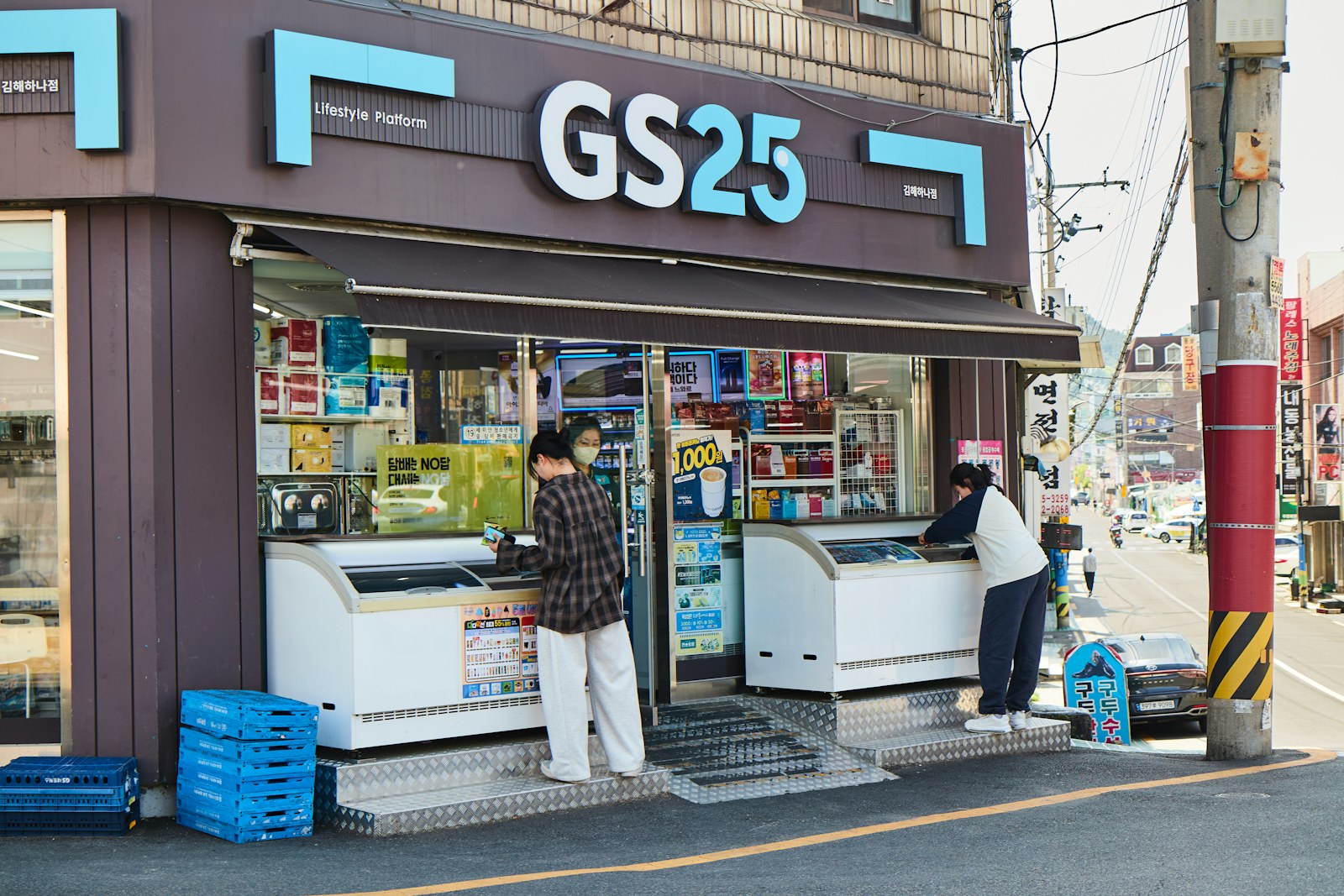
Korean neighborhoods sometimes look absurd from a retail-planning perspective. A CU on one corner. GS25 seventy meters away. A 7-Eleven across the road. Another chain inside the apartment complex.
For consumers this is wonderful. If one store is out of the ramen you want, the next store is a minute away.
For owners, it can be brutal.
Chain headquarters benefit from network density and strategic locations. Competitors do not want to surrender a block. But the neighborhood’s population does not double simply because a second store opens.
The sales get divided.
By 2025, Korea’s major convenience-store count finally declined year-on-year, a symbolic turning point for an industry that had spent decades expanding. The game is shifting from “open more stores” to “make each store more productive.”
That makes the store a viciously good product laboratory
For food and beverage companies, Korean convenience stores are one of the fastest ways to discover whether an idea is actually good.
In the meeting room, everyone likes the new snack.
The package tests well.
The agency loves the concept.
The executives nod.
Then the product enters a convenience store.
Three weeks later, reality sends an invoice.
Do people pick it up? Do they buy again? Does a 1+1 promotion move it? Does it appear on social media? Does a celebrity collaboration matter? Is the package visible from two meters away? Will anyone pay an extra 500 won?
The shelf is a ruthless focus group that does not care how beautiful the PowerPoint was.
Korea’s FMCG marketing school is open 24 hours
This helps explain the extraordinary churn of products in Korean convenience stores: limited-edition drinks, character collaborations, celebrity-branded food, seasonal desserts, new instant noodles, canned highballs, convenience-store-only products, restaurant partnerships and private labels.
The store is small, so every centimeter has to justify itself. New products compete for attention in seconds. A weak package dies quietly.
For marketers, this is one of the best live classrooms in the country.
For store owners, it is also the classroom where somebody has to check the expiration date.
The franchise looks like a corporation and behaves like a small business
This duality is the key to the industry.
Headquarters sees national sales data, logistics efficiency, category performance and product strategy.
The individual franchisee sees rain outside the window and five unsold lunch boxes at 10 p.m.
The system operates like a large corporation.
The shop operates like self-employment.
Both are part of the same business, but they do not experience risk in the same way.
Is the convenience store a graveyard for the self-employed?
That description is too dramatic. Many franchisees earn stable incomes. Some operate multiple stores successfully. Good locations and disciplined operations matter.
But it would also be wrong to explain Korea’s convenience-store density entirely as consumer demand. There was enormous supply of would-be entrepreneurs too: retirees, people locked out of better jobs, landlords with street-level space, and franchise companies competing for coverage.
The convenience-store map is therefore also a map of Korea’s labor market and retirement system.
Koreans did not necessarily need twice as many convenience stores per person as Japan.
A lot of people were also willing — or felt compelled — to stand behind the counter.
Consumers got an extraordinary infrastructure out of the bargain
There are real social benefits. A brightly lit store can be a small safety anchor late at night. For a one-person household, it is an external pantry. For tourists, it is a low-risk introduction to Korean food. For delivery and parcel networks, it is a local node. For manufacturers, it is a testing ground.
E-commerce can deliver almost anything to your home. But there are still moments when a store eighty meters away beats the world’s best logistics network.
Korea filled those last eighty meters with convenience stores.
And now Korea is exporting the experience
Korean convenience-store brands have expanded in countries such as Mongolia and Malaysia, often carrying Korean food, instant noodles and pop-culture tie-ins with them.
That is an important shift. Korea once imported the convenience-store idea. Now it exports a Korean version of the experience.
The shelves are part retail system, part cultural package.
Apparently even “convenience store” can acquire a K.
The growth era is ending. The harder exam begins
If store counts stop rising, chains can no longer win simply by being closer. They need larger formats, better private labels, stronger food, better experience and more profitable stores.
That may be healthy. A mature industry should care less about how many franchisees it can recruit and more about whether existing franchisees can make a living.
So if a Korean retiree walks into a franchise consultation holding a lifetime of savings, somebody should explain the model with complete honesty.
The convenience store is an excellent system designed so that a beginner can operate it.
Unfortunately, the person across the street bought the same textbook.