Korea Had “Free” Delivery Before Delivery Apps. So Who Put a Price on It?
Long before food-delivery platforms, a phone call could send jjajangmyeon across town on a motorbike. Delivery was never free. The price was simply hidden inside a much simpler business.
For decades, ordering Chinese food in Korea followed a remarkably short script.
You found the restaurant’s number on a paper flyer. You called. “Two jjajangmyeon and one jjamppong, please.” You gave the address and hung up.
A while later, a motorbike arrived. The delivery worker opened a metal case, handed over black-bean noodles in heavy ceramic bowls and collected payment. After eating, you placed the bowls outside the door. The restaurant came back for them later.
No app. No delivery platform. No separate payment screen. No restaurant-discovery algorithm. Usually no visible delivery charge.
It feels almost prehistoric now, except the service was extremely convenient.
Chinese restaurants were Korea’s original delivery platforms
Food delivery became widely established in Korea decades before smartphones, with Chinese restaurants — especially jjajangmyeon shops — at the center of the culture. Dense apartment complexes and compact urban neighborhoods made the economics unusually favorable. One restaurant could serve hundreds or thousands of households within a short motorbike radius.
The restaurant did everything itself.
It cooked the food. It took the order. It remembered customers. It employed the delivery worker. It handled payment. It recovered the bowls. In modern startup language, it was vertically integrated to an almost comic degree.
A local Chinese restaurant was kitchen, call center, CRM system, logistics company and reverse-logistics operation.
The technology stack was a landline and a steel box.
The steel delivery case became a cultural symbol
For Koreans of a certain age, the silver metal delivery case instantly evokes the Chinese-food delivery worker. It became such a familiar part of city life that it could be used in jokes, films and political imagery without explanation.
This matters because it reminds us that delivery was not an “innovation” imported by smartphones. Students ordered food during late-night study sessions. Offices ordered during overtime. Families ordered on moving day. People ordered because Korea’s dense cities made fast local delivery sensible long before Silicon Valley discovered the word “last mile.”
The app did not invent the habit.
It industrialized the middle.
The old delivery charge was invisible, not nonexistent
When Koreans say “delivery used to be free,” what they usually mean is that the customer did not see a separate line item.
The restaurant still had to buy a motorbike, pay for fuel and employ a worker. Delivery was embedded in the price of the food and in the restaurant’s operating model.
This is important because modern delivery fees can create the illusion that somebody recently invented a new cost. The cost was always there.
What changed was who performs each function, who sees the customer, and who gets paid separately.
The app solved a different problem
By the time smartphones arrived, Korea already knew how to deliver food. The problem was discovery.
What should I eat?
Which restaurant is good?
What is the phone number?
What is on the menu?
Is it open?
Does it take cards?
What did other customers think?
Apps compressed all of this into a screen.
That was genuinely useful. Small restaurants without their own delivery employees could enter the market. Consumers could compare dozens of restaurants. Payments became easier. Ratings created new forms of trust.
But something else moved at the same time.
Customer knowledge moved away from the restaurant.
The restaurant used to know you. Now the platform does
An old neighborhood restaurant might recognize your address from your voice. Today the platform knows much more.
What you searched for. What you ordered. How much you spent. What time you usually order. Which coupons move you. How sensitive you are to delivery fees. Whether you order fried chicken on rainy Fridays.
The restaurant still cooks the food.
The platform increasingly owns the map of appetite.
This is the deeper economic shift. Delivery apps did not merely add convenience. They inserted a new commercial layer between restaurants and customers — a layer with search, data, advertising, ranking and payment power.
Once the middle becomes essential, the middle can charge rent
At first the bargain was attractive to everyone. Restaurants got customers. Consumers got choice. Riders got a new labor market. Platforms got a fee for coordinating the system.
Then the platforms became very large.
By 2026, Baemin and Coupang Eats together accounted for about 93 percent of Korea’s delivery-app market in government discussions. At that level, telling a restaurant owner “just don’t use the app” starts to sound like telling a shop owner “just don’t rent in the neighborhood where the customers are.”
The platform has become a digital high street.
Commission fees can therefore feel less like optional software charges and more like commercial rent.
“Free delivery” made a return, which is funny if you remember the beginning
Korean customers eventually got used to seeing delivery fees separated from food prices. Then platform competition brought “free delivery” back as a marketing weapon.
Of course, motorcycles do not run on optimism.
The cost still exists. It may be covered by a subscription, absorbed by the restaurant, subsidized by the platform, or folded into menu prices. “Free” usually means the price tag has changed location.
The history almost makes a circle.
Old Chinese restaurant: delivery cost hidden inside the meal.
Platform era: delivery cost displayed separately.
Subscription era: delivery cost hidden again.
Economics has a sense of humor.
The rider changed too
The traditional delivery worker belonged to the restaurant. That was not necessarily a good job; it could be dangerous, low-paid and unstable. But the employment relationship was clear.
Platform riders gained different kinds of freedom. They can switch apps, work flexible hours and deliver for many restaurants. But they also carry new uncertainty: per-order pay, algorithmic assignment, weather risk, insurance, traffic danger and fluctuating demand.
On the customer’s screen, the rider is a moving icon.
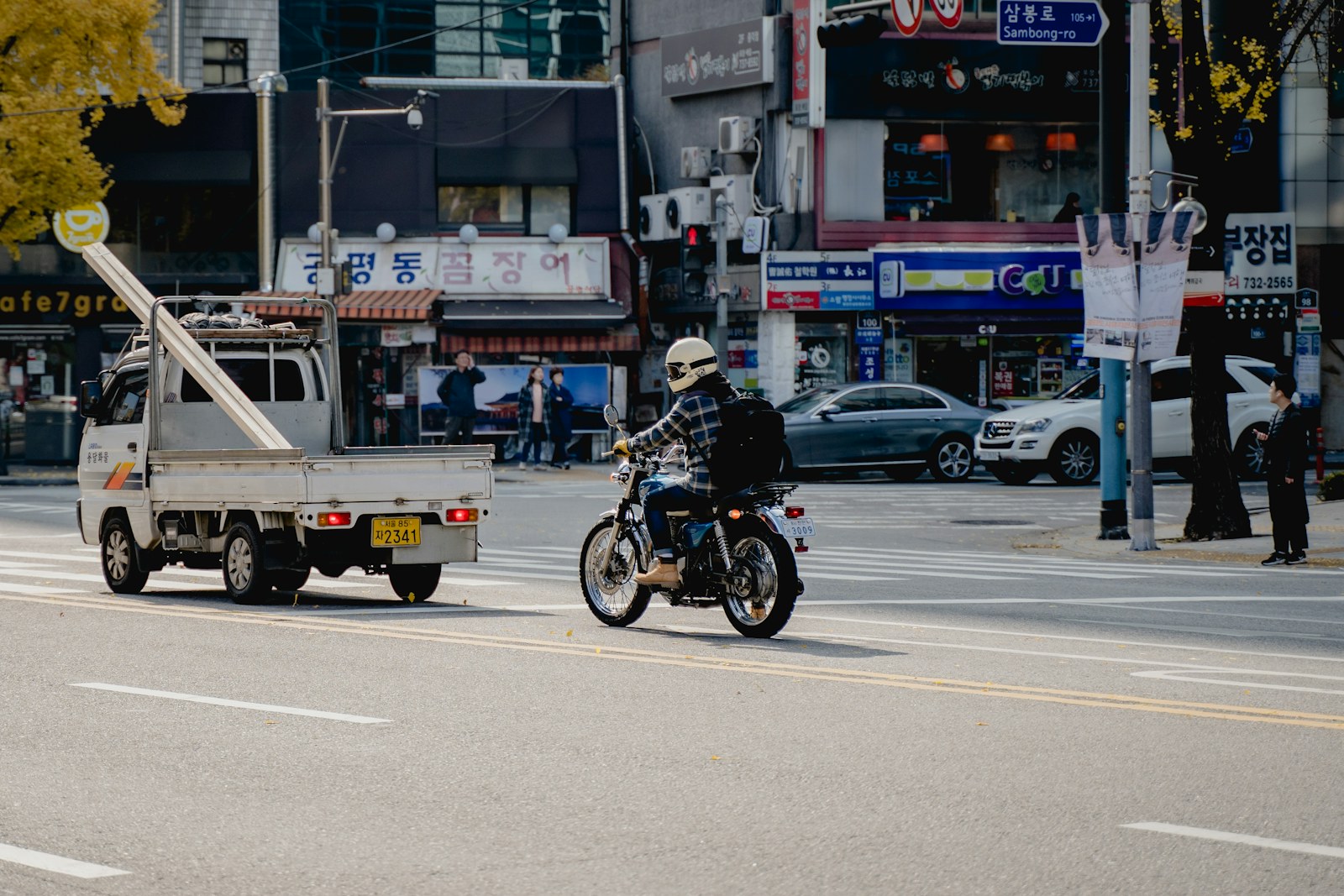
In traffic, the icon is a person on a motorcycle trying to make the next light.
Then Korean dinner became connected to German and American capital
The corporate story adds another layer of absurdity.
Baemin operator Woowa Brothers became part of Germany’s Delivery Hero group. In 2026, Uber announced an agreement to acquire Delivery Hero, subject to regulatory approvals and other conditions.
So a Korean customer can order Korean food from a Korean restaurant, delivered by a Korean rider, through an app whose parent company sits in Germany and may ultimately be acquired by an American technology company.
The jjajangmyeon has not changed very much.
The cap table has.
This is not a simple story about greedy platforms
The old system had serious limitations. Only restaurants capable of running delivery operations could participate. Consumers had fewer choices and less information. Cash was common. Quality was hard to compare. Small restaurants often lacked reach.
Platforms genuinely improved all of that.
The question is not whether the middleman deserves to be paid. The question is how much power the middleman acquires once both sides need the same marketplace.
This is the same problem seen in app stores, online travel agencies, e-commerce marketplaces and ride-hailing.
A marketplace begins by helping businesses find customers.
Eventually businesses may find that the marketplace owns the road to the customer.
The steel box and the smartphone
The old delivery case contained a small local economy: restaurant, worker, customer, motorbike, bowls.
The smartphone contains far more: thousands of restaurants, ratings, payments, real-time tracking, coupons, subscriptions, advertising, algorithms, gig labor and international capital.
The modern system is undeniably more powerful.
It is also more crowded.
So perhaps the most interesting question is not why delivery “became expensive.”
Delivery always had a cost.
The real question is when the road between restaurant and customer became valuable enough that somebody could build a tollbooth on it.