In Korea, Your Phone Number Is Basically an ID Card
One of the world’s most connected countries can feel strangely closed if you do not have the right SIM card. Korea’s digital life is wonderfully efficient once the system knows exactly who you are.
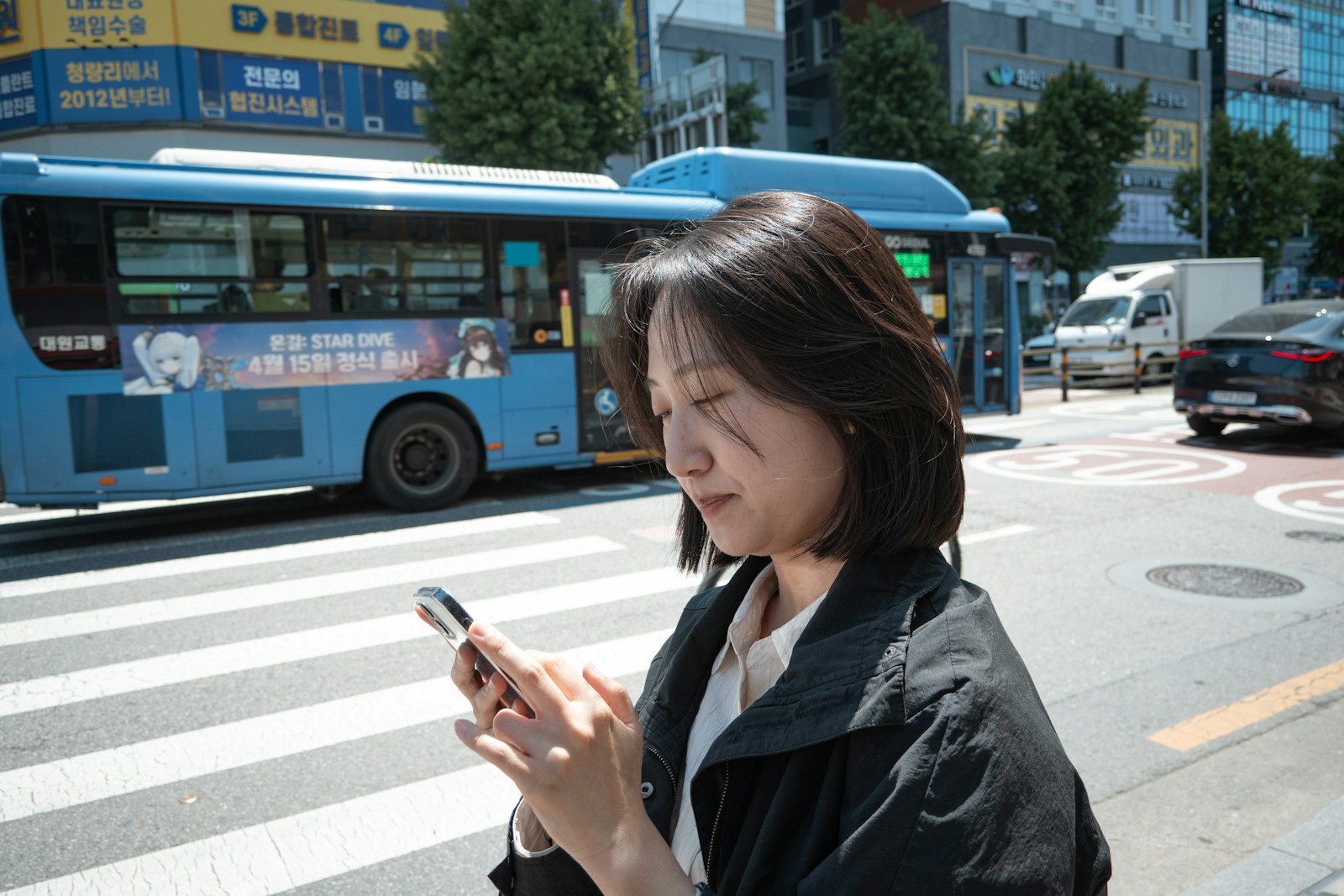
A foreigner arrives in Korea and tries to sign up for a local service. Name. Date of birth. Password. Fine. Then comes the screen that quietly separates visitors from residents: mobile phone identity verification.
No Korean number? Stop.
You get a number and try again. The spelling of your name does not match the telecom company’s record. Perhaps the family name came first in one database and last in another. Perhaps there is a space. Perhaps there is no space. The human being is obviously the same. The databases are not emotionally persuaded.
For Koreans this rarely feels strange because they grew up inside the system. For everyone else it can feel like discovering that a phone number has somehow been promoted from “contact detail” to “minor government document.”
A Korean SIM card is part phone number, part keycard
South Korea’s online identity system uses several verification methods, but mobile-phone verification became one of the most common because virtually everyone already had a phone registered under a real identity. The telecom account can confirm that a name, birth date and phone number belong to the same person.
In the United States, websites often treat a mobile number as a convenient way to send a security code. In Korea, it can function more like a lightweight digital ID. It is not quite a Social Security number, not quite an Estonian digital ID and not quite India’s Aadhaar. Functionally, it sits in an odd space between them: a commercial telecom account that became a crucial door key to digital life.
Banking. Shopping. Password recovery. Ticketing. Public services. Age verification. Account creation. The same ritual appears again and again: choose your carrier, enter your information, receive the code, prove that you are you.
The system was not invented to annoy foreigners. It grew from real problems: online fraud, identity theft and the danger of websites collecting national registration numbers too casually. Replacing direct use of the resident registration number with separate identity-verification mechanisms was, in many ways, an improvement.
The trouble with systems built for almost everyone is what happens to everyone else.
A single spelling error can temporarily erase a person
Korea’s databases are very good at exact matches. Human names are less cooperative.
Foreign residents can have names recorded in different orders, scripts or spacing conventions across immigration records, banks and telecom companies. Reforms have reduced some of these problems, but the broader lesson remains: a system built around exact identity matching can make a perfectly legitimate human being look suspicious because two databases disagree about a hyphen.
There is something almost philosophical about this. To a friend, you are obviously you. To a server, you are the intersection of several strings that must match.
Korea tends to trust the intersection.
Then Apple Pay arrived — in 2023
Now the story gets more interesting.
Korea is not a technological laggard. It has fast networks, advanced banking apps, extremely high smartphone use and a population comfortable doing serious financial business on mobile devices. Yet Apple Pay did not officially launch in South Korea until March 21, 2023, long after it was available in dozens of other markets.
This sounds backwards until you look at the infrastructure underneath. Korea already had a dense domestic card network, payment gateways, card companies, terminals, mobile wallets and regulatory arrangements that worked very well for local users. A new international standard did not arrive in an empty field. It arrived in a field full of buildings.
Sometimes a country adopts the next technology slowly not because it failed to modernize, but because the previous modernization worked too well.
Success can be technical debt wearing a nice suit.
Stripe produces the same strange feeling
A Korean developer building a global online store may hear the standard international advice: “Just use Stripe.” Then they open Stripe’s supported-country list.
United States. United Kingdom. Japan. Singapore. Thailand. Much of Europe.
South Korea is still not on the list for ordinary locally registered Stripe Payments accounts as of 2026.
The irony is delicious. Korea has one of the world’s most sophisticated e-commerce markets, but a Korean business cannot simply sign up for the same payment stack that a startup in many other markets treats as plumbing.
PayPal has its own Korean peculiarities. Korean PayPal accounts can participate in cross-border payments, but domestic payments between Korean PayPal accounts are restricted. Again, the reason is not that Korea lacks digital payments. It is that Korea already has an entire domestic payments universe that evolved on its own terms.
China makes the contrast uncomfortable
Korea is nearly cashless, but it reached that point through cards. China moved much more aggressively into QR-based mobile wallets. The result is that tiny merchants, street stalls and taxis in China often operate within Alipay or WeChat Pay ecosystems that feel less like “card payments on a phone” and more like a completely separate financial layer.
China has also spent years reducing friction for foreign visitors, allowing international cards to be linked to major mobile wallets. Korea is moving toward more cross-border QR interoperability too, but the comparison exposes the difference between an excellent domestic system and an internationally legible one.
Korea built a superb local highway network.
Sometimes the airport interchange is the problem.
Koreans do not feel the wall because they are standing inside it
A Korean resident with a local phone number, local bank account, local card and Korean-language literacy can move through the system almost frictionlessly. Payments are fast. Apps connect. Verification works. Government services are astonishingly convenient.
That is precisely why the blind spot persists. Designers, developers, bankers and policymakers usually live inside the same ecosystem as the majority of their users. They experience integration as convenience. A foreigner experiences the missing prerequisites as a locked door.
The problem is not that Korea is badly connected.
It is that Korea is extremely well connected to itself.
And then there is the Korean phrase “I think…”
There is a curious cultural contrast here. Modern conversational Korean often uses the equivalent of “I think,” “it seems,” or “I guess” even when the speaker is expressing a fairly direct personal judgment. “It’s good” becomes “I think it’s good.” “That’s expensive” becomes “It seems a little expensive.” Linguists would describe this kind of softening as hedging: it reduces the force of a statement and leaves a little room to retreat.
It would be sloppy to claim that Koreans suddenly started speaking this way because they are afraid of responsibility; language is more complicated than that. But the contrast is too good to ignore.
The human conversation becomes softer: “I think this might be right.”
The server becomes harder: “Please prove your legal identity.”
Korean speech often leaves an escape hatch. Korean authentication prefers the door welded shut.
The paradox of a global country with local defaults
Korean companies want to sell abroad. K-pop, K-beauty and Korean food have global audiences. Startups talk about global markets from day one. The government wants tourists, foreign talent and international investment.
Yet a foreign visitor may encounter a service that assumes a Korean phone number. A Korean merchant may discover that Stripe does not support a normal Korean account. A global product may launch later in Korea because Korea requires additional local work.
Each side is tempted to blame the other.
Koreans ask, “Why don’t global companies support us properly?”
Global companies ask, “Why does Korea need special handling?”
Both questions are fair. Neither is flattering.
What Korea built is not primitive. It is specific
This distinction matters. Korea’s digital identity and payment systems are not awkward because the country failed to modernize. Many of the awkward parts are the archaeological remains of earlier success: real-name systems, telecom identity, card networks, domestic gateways and rules that solved yesterday’s problems extremely well.
Newer systems do not arrive on bare ground. They must connect to what already exists.
That is why a country can be simultaneously advanced and annoying.
Once a foreign resident gets a properly registered phone number, local bank account and card, doors start opening. Shopping works. Delivery works. verification works. The person has not merely bought a SIM.
They have acquired something closer to digital residency.
A few months later they may find themselves on a new Korean website, entering their number and waiting for the six-digit code without thinking about it.
At that point, the integration is complete.
At least the server thinks so.