
Cute Face, Vampire Fangs, and a Scream From Hell
Meet the Korean Water Deer — Rare in the World, Everywhere in Korea, and Hated by Farmers
Show a picture of a Korean water deer to someone who has never seen one before, and the first reaction will probably be:
“Aww. Cute.”
Fair enough.
Huge ears.
Big dark eyes.
A tiny black nose.
Soft brown fur.
A nervous little face that looks like it belongs in a Disney movie.
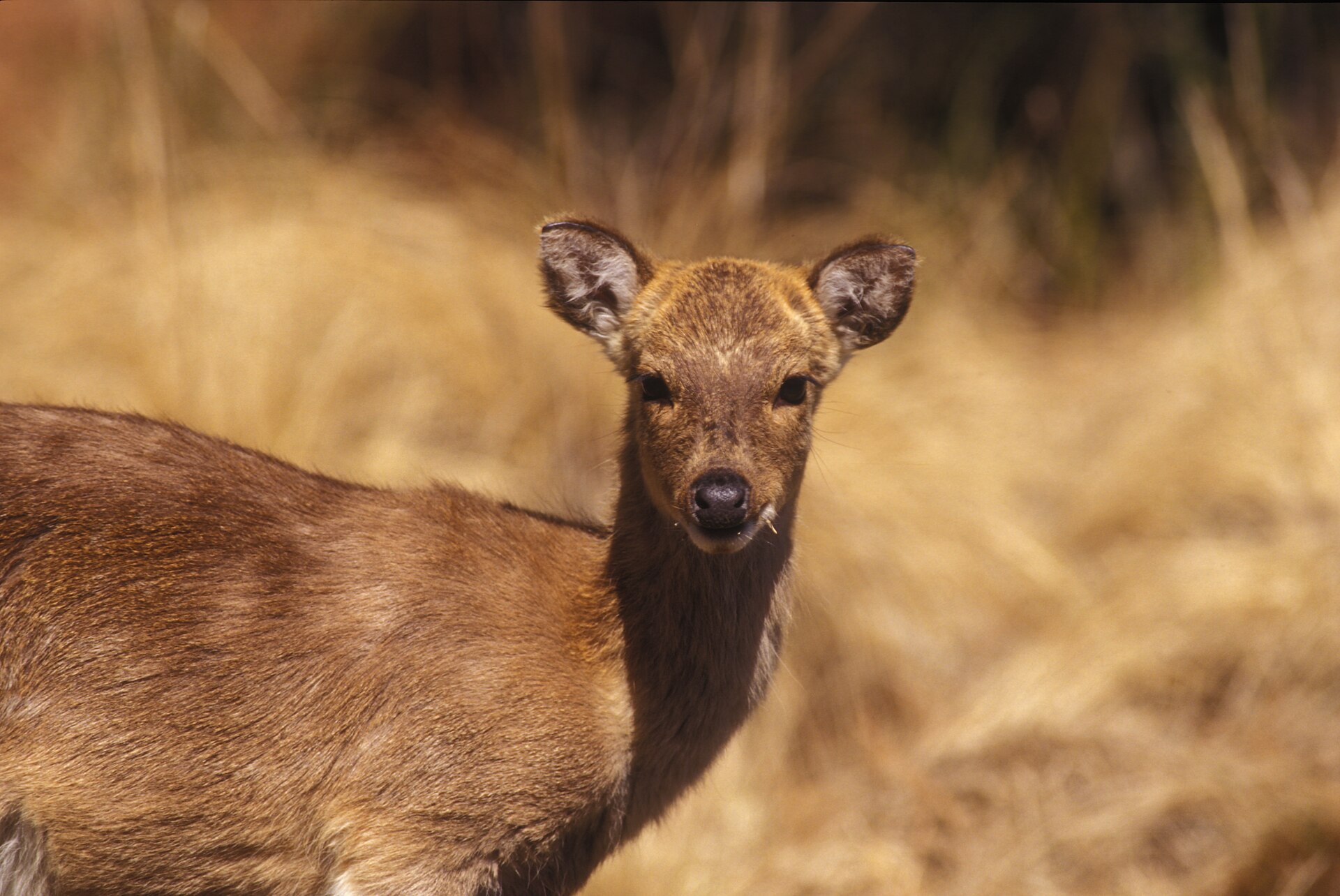
Then a male opens his mouth.
Two long canine teeth hang down from his upper jaw.
Suddenly, Bambi has become Dracula.
And then night falls.
Somewhere in the darkness, that adorable animal lets out a scream that sounds less like a deer and more like someone being murdered in a horror movie.
If you have ever served in the Korean military near mountains or farmland, there is a decent chance you know the sound.
A new soldier is standing guard at night.
A terrifying scream comes from the woods.
“What the hell was that?”
The senior soldier barely looks up.
“Water deer.”
Cute face.
Vampire teeth.
Horror-movie voice.
And those are only the beginning of the contradictions.
Globally, the species is considered vulnerable.
In South Korea?
There are so many of them that farmers curse at them.
They eat crops.
They appear constantly on rural roads.
They are one of Korea’s most notorious roadkill animals.
In certain situations, Korean law even classifies them as wildlife that may be controlled because of agricultural damage.
Someone overseas might say:
“How can you kill such a rare animal?”
A Korean farmer might answer:
“Rare? Come look at my field tonight.”
Both can be right.
And that is what makes the Korean water deer such a strange animal.
First of All, Why Is It Called a “Water Deer”?
Its scientific name is Hydropotes inermis.
Its English name is simply:
Water deer.
It is a small member of the deer family whose natural range historically included the Korean Peninsula and parts of China.
There is also a well-established population in Britain, but those animals descend from water deer introduced by humans.
So saying
“water deer exist almost only in Korea”
would be an exaggeration.
But saying
“this is a globally restricted species that is strangely abundant in South Korea”
is much closer to the truth.
That contradiction is central to the story.
Globally, water deer have been assessed as a Vulnerable species.
In South Korea, meanwhile, they are one of the most commonly encountered medium-sized wild mammals.
A 2024 national wildlife survey by the National Institute of Biological Resources put the average density in surveyed plots at 9.1 animals per square kilometre.
Around the world:
“We need to conserve water deer.”
In Korea:
“Oh, another one.”
It Is a Deer With No Antlers
Look closely at a water deer and something else is missing.
Antlers.
When most people imagine a male deer, they imagine a magnificent rack of antlers.
Not here.
Neither male nor female water deer grow antlers.
The male evolved something else instead.
Fangs.
Long upper canine teeth extend outside the mouth.
In large males, the exposed canines can reach about 8 centimetres.
This is why English-language media often call them:
“vampire deer.”
No, they do not drink blood.
The fangs are weapons used mainly in competition between males, especially during the breeding season.
Males can injure one another with them, leaving scars around the head and neck.
Even stranger, the teeth are not simply rigid daggers sticking permanently forward.
The animal can control their position to some degree with facial muscles.
When eating, the canines can be drawn back.
When threatening another male, they can be presented more prominently.
In other words, this cute little deer walks around with something close to
a pair of folding knives in its mouth.
It Is Smaller Than You Think
Pictures can make the water deer look like a full-sized deer.
It is not.
Adults are generally around 80 to 100 centimeters long and often weigh roughly 9 to 14 kilograms.
That puts them in the general weight range of a medium-sized dog.
They are small.
Their tails are extremely short.
Their hind legs are relatively powerful.
When they run, they sometimes look less like a majestic deer crossing a forest and more like
a giant rabbit bouncing desperately through grass.
And then there are the ears.
Huge.
Almost comically large for the head.
Standing still, a water deer is genuinely beautiful.
The trouble begins when it opens its mouth.
Or starts screaming.
About That Scream…
No article about Korean water deer is complete without the sound.
You might expect a little deer to make a gentle, delicate noise.
It does not.
Water deer use several vocalizations, including barking alarm calls.
During breeding and moments of extreme stress, they can produce other harsh, penetrating sounds.
And some of those calls sound uncannily human.
Especially at night.
Deep in the countryside, a sudden water-deer scream can sound like:
a person screaming,
a dog barking strangely,
or something supernatural having a very bad evening.
This is why the animal has become a minor legend among people who served in the Korean military.
Many Korean military bases sit near mountains, forests and agricultural land.
For some soldiers, their first encounter with a water deer happens at two in the morning while standing guard.
Not visually.
Acoustically.
And that is probably the worst possible way to meet one.
Look at the animal first.
Then listen.
The natural reaction is:
“That sound came out of THAT?”
So Why Are There So Many Water Deer in Korea?
This is the important question.
Yes, the Korean Peninsula is part of the species’ natural range.
But that alone does not explain why the animal is so common in South Korea today.
Several conditions work in its favor.
1. Korea Is Basically Excellent Water-Deer Real Estate
Water deer prefer landscapes that include wetlands, rivers, reeds, grassland and dense vegetation.
But they are not restricted to literal watersides.
They can make excellent use of:
low mountains,
forest edges,
rice fields,
vegetable farms,
irrigation channels,
riverbanks,
bushes,
and mixed agricultural landscapes.
Now picture a typical Korean rural landscape.
A low mountain.
A field underneath it.
Rice paddies.
A stream.
Irrigation ditches.
Tall vegetation.
Shrubs.
To a water deer, this is not just countryside.
It is
prime real estate.
Food nearby.
Cover nearby.
Water nearby.
Escape routes everywhere.
2. Most of Their Big Predators Are Gone
Historically, the Korean Peninsula had animals capable of preying on medium-sized ungulates.
Tigers.
Leopards.
Wolves.
In modern South Korea, those large terrestrial predators are effectively absent.
When top predators disappear, one of the natural forces controlling herbivore populations weakens.
This does not mean predator loss alone explains Korea’s water-deer population.
Ecology is rarely that simple.
But the lack of large predators almost certainly changes the equation.
Once upon a time, a water deer peacefully eating vegetation might itself become dinner.
Today, in South Korea, that risk is dramatically lower.
3. They Are Surprisingly Productive Breeders
Water deer are unusual among deer in another way.
They can produce relatively large litters.
While many deer species commonly give birth to a single fawn, water deer often produce several young.
Larger litters have also been recorded.
So now we have:
plenty of suitable habitat,
plenty of food,
few large predators,
and relatively high reproductive potential.
That is a fairly good recipe for having lots of water deer.
Then Humans Accidentally Built Them an All-You-Can-Eat Buffet
This is where the relationship between water deer and Korean farmers gets ugly.
Water deer are herbivores.
If they quietly ate wild vegetation all their lives, humans might barely notice them.
Unfortunately, humans created something rather tempting.
Imagine being a wild herbivore and discovering that another species has:
cleared a large area,
planted thousands of the same tender plants,
arranged them in neat rows,
removed much of the competing vegetation,
and carefully maintained them for months.
We call this:
a farm.
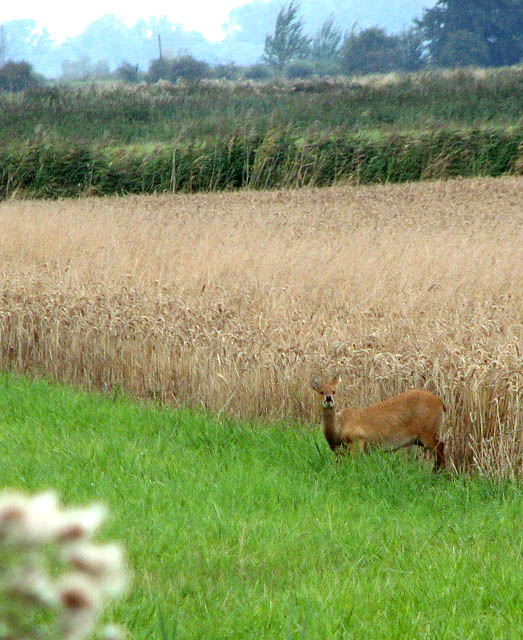
To the water deer, it may look more like:
an enormous salad bar.
The animal has no concept of property rights.
It does not understand:
“That cabbage represents months of someone’s labor and future income.”
It sees food.
The farmer sees an entire season’s work.
That is where sympathy becomes complicated.
Farmers Are Not Complaining for Fun
Imagine planting seedlings.
Fertilizing them.
Removing weeds.
Managing pests.
Waiting for months.
Then walking outside in the morning and discovering that several animals came through during the night and ate the tender new growth.
Do that once and the deer is cute.
Do that repeatedly and the phrase
“globally vulnerable species”
may stop producing an emotional response.
This is why water deer are treated as agricultural pests in parts of South Korea.
Under the enforcement rules of Korea’s Wildlife Protection and Management Act, water deer that reach high local densities and damage agriculture, forestry or fisheries are listed as harmful wildlife subject to damage control.
This does not mean the species is officially considered evil.
It means that, in specific places, local populations can become high enough to create genuine economic damage.
That distinction matters.
Ecology does not have morally good animals and bad animals.
The water deer is not sneaking into a cabbage field because it hates farmers.
It is eating.
The problem is that human property and wildlife habitat overlap.
So Is the Water Deer a Harmful Animal?
The most accurate answer is annoyingly boring:
It depends.
The species itself is not an invasive pest in Korea.
It is native to the peninsula.
It belongs in the ecosystem.
Globally, it has substantial conservation value.
But if local populations become dense enough to repeatedly damage agriculture, then they clearly create a human-wildlife conflict.
If they run onto roads, they become dangerous to both drivers and themselves.
So the sensible answer is neither:
“Protect every single water deer no matter what.”
nor:
“Kill them all because they eat crops.”
Real wildlife management is uglier and more complicated.
Population control where necessary.
Fencing.
Wildlife crossings.
Roadkill prevention.
Habitat planning.
Compensation for farmers.
Targeted removal in serious damage areas.
The question is not whether water deer are good or bad.
The question is:
How many can a particular landscape support without creating unacceptable conflict?
Globally Vulnerable. Locally Abundant.
This is probably the most interesting ecological contradiction of all.
Across its entire natural range, the water deer has a restricted distribution.
Populations in China have declined substantially in many places.
That gives the species genuine conservation importance.
But South Korea has a large population.
So the same animal can be:
a species conservationists worry about globally
and
an animal wildlife managers may need to control locally.
There is no contradiction.
Species conservation and local population management operate at different scales.
A species can be globally threatened while being locally abundant.
That is exactly the kind of nuance that disappears when wildlife gets divided into simple categories like:
“endangered = never touch”
and
“pest = worthless.”
Nature is rarely that convenient.
On Korean Roads, the Story Gets Much Darker
There is another place where Korea’s abundance of water deer becomes painfully visible.
The road.
Water deer are among South Korea’s most common roadkill mammals.
One study estimated at least 60,000 water deer roadkill cases a year in South Korea.
On expressways alone, Korea Expressway Corporation figures reported in 2025 showed that of 5,300 animal collisions between 2020 and 2024, 4,426 — 83.5% — involved water deer.
They frequently cross roads between feeding and resting areas, especially around rural landscapes and forest edges.
At night, a driver may suddenly see a small deer leap into the road.
The driver thinks:
“Why did that idiot jump in front of my car?”
The deer would presumably have a different interpretation.
Humans built a strip of high-speed asphalt through its habitat.
So who crossed whose road?
It depends on the map.
Road collisions are one of the biggest points of contact between ordinary Koreans and wild water deer.
Unfortunately, that contact often lasts only a few seconds.
And Yes, Dogs Really Do Kill Them
Another common Korean observation is that dogs — especially free-ranging or feral dogs — sometimes catch and kill water deer.
This is not just folklore.
There are documented cases and actual footage of packs of dogs chasing, attacking and feeding on water deer in South Korea. In Daejeon, two feral dogs were filmed hunting and eating a water deer near an urban road.
But there is an important distinction.
It is fair to say:
dogs can and do hunt water deer.
It is harder to prove:
water deer are unusually easy prey for dogs compared with other similarly sized wildlife.
Water deer themselves can run quickly and swim well.
The more significant problem is that dogs hunting in groups can become effective predators.
Which creates another strange Korean ecological story.
Humans Removed the Native Predators — Then Created New Ones
Tigers disappeared.
Leopards disappeared.
Wolves are effectively gone from South Korea.
Then humans domesticated dogs.
Some dogs were abandoned or became feral.
Those dogs formed groups.
And some began hunting wild animals including water deer.
There is something deeply strange about that sequence.
Humans largely removed the original predators from the landscape.
Then animals humans created through domestication returned to the wild and began partially filling a predatory role.
That does not mean feral dogs are somehow good because they kill water deer.
They can also attack other wildlife, livestock and sometimes threaten people.
An ecosystem is not a spreadsheet where one missing predator can simply be replaced with another.
And Now the Question Koreans Eventually Ask: What Does It Taste Like?
If South Korea removes so many water deer for agricultural or wildlife-management reasons, one obvious question appears.
Why don’t Koreans eat them?
Wild boar meat is at least somewhat familiar in Korea.
But nobody casually says:
“Let’s go out for water-deer barbecue tonight.”
There are almost no mainstream restaurants specializing in it.
And this has produced another layer of Korean water-deer folklore.
“It doesn’t taste good.”
People who have spent time around rural hunting communities or the military may remember stories that even when a water deer was killed, people were not particularly eager to eat it.
But here we have to separate folklore from evidence.
“Water Deer Taste Bad” Is More of a Reputation Than a Scientific Fact
There does not appear to be a large body of rigorous sensory research proving that water-deer meat is inherently unpleasant.
Anecdotal reports vary.
Some people describe wild deer meat as gamey, strong-smelling or unpleasant.
Others say properly handled venison can be lean and quite good.
And handling matters enormously.
How quickly was the animal bled?
How soon were the organs removed?
Was the carcass cooled properly?
Was the animal highly stressed before death?
How was the meat aged?
Which cut was used?
How was it cooked?
All of these things influence wild-game flavor.
So it is reasonable to say:
“Water deer have a reputation in Korea for not being especially desirable meat.”
It is much harder to say:
“Biologically, water deer are simply bad-tasting animals.”
That claim goes too far.
The poor animal has enough problems already.
People curse it while it is alive for eating crops.
Then insult it after death for not tasting good enough.
And You Cannot Simply Kill One and Take It Home for Dinner
Another misconception is that because water deer may be controlled as agricultural pests, anyone can simply shoot or capture one and eat it.
No.
Wildlife capture in South Korea is regulated.
Control operations require legal authorization and procedures.
Carcass handling and disposal are also regulated.
There are also basic health reasons not to treat wild animals like supermarket meat.
Wild deer can carry parasites, ticks and pathogens. Korean studies have surveyed tick-borne pathogens and parasitic protozoa in water deer.
Wild-game meat that has not gone through proper handling and inspection creates risks that commercially slaughtered livestock does not present in the same way.
So:
“There is a dead water deer by the road. Free barbecue.”
is not a particularly good plan.
Surprisingly, They Are Good Swimmers
The English name Water Deer is not completely decorative.
They are comfortable around wetlands and waterways and can swim well.
For an animal with skinny legs and the general appearance of someone permanently startled by life, they are surprisingly capable in water.
This adds another item to the increasingly bizarre résumé:
A deer with no antlers.
Vampire fangs instead.
Cute face.
Terrible scream.
Small body.
Rabbit-like running.
Good swimming ability.
Large litters.
Globally vulnerable.
Locally abundant.
Korean nature apparently decided one contradiction was not enough.
And Yes, They Have an Ecological Role
When farmers describe water deer as pests, it can become easy to imagine that the animals contribute nothing useful.
That would be wrong.
Water deer are native herbivores.
Like other herbivores, they interact with vegetation.
They eat plants.
Move through habitats.
Defecate.
Transport biological material.
Become prey.
Influence plant communities.
A 2025 study examined the role of Korean water-deer droppings in seed dispersal and germination across several plant species.
This does not mean:
“Water deer are beneficial, therefore farmers should tolerate unlimited crop damage.”
It means only that wild animals exist inside ecological relationships that are larger than their usefulness to humans.
A creature can have ecological value and still create serious economic damage.
Both can be true.
Korea May Be One of the Species’ Most Important Strongholds
And here is where the story changes again.
In parts of China, the species’ native population and habitat have declined.
South Korea, by contrast, still supports a very large wild population.
That means Korean water deer are not merely:
“those annoying animals we have too many of.”
From a global conservation perspective, South Korea may represent one of the species’ most important remaining strongholds.
That has consequences.
Management needs to be intelligent.
Not sentimental.
Not indiscriminate.
If the population is too high in one agricultural district, reduce conflict there.
If road mortality is severe, improve crossing structures.
If farmers are absorbing wildlife costs for the rest of society, improve compensation and prevention.
But preserving a healthy long-term population matters too.
The fact that South Korea has many water deer is not a reason to treat them as worthless.
It is one reason Korea has a special responsibility for the species.
The Strangest Thing About Water Deer May Be How Ordinary They Seem to Koreans
Familiarity is powerful.
People rarely appreciate what they see every day.
To many Koreans, the water deer is:
the animal that jumps onto roads,
the animal that destroys crops,
the thing screaming outside a military base,
the carcass on a rural highway.
Nothing exotic.
Nothing special.
But show the same animal to someone from a country where it does not naturally exist.
They see:
a rare Asian deer,
a primitive-looking antlerless species,
a fascinating evolutionary oddity,
a “vampire deer.”
The difference is not the animal.
The difference is familiarity.
One Animal, Completely Different Depending on Who Is Looking
To a conservation biologist:
a restricted-range native deer with global conservation significance.
To a Korean farmer:
the bastard that ate the seedlings again.
To a driver at 2 a.m.:
something that suddenly appeared in the headlights.
To a Korean soldier:
the thing screaming in the mountains during night duty.
To a pack of feral dogs:
prey.
To an overseas wildlife enthusiast:
“Oh my God, it’s adorable.”
And to a male water deer looking in the mirror:
presumably,
“Yes, the fangs are natural.”
Look at the Face One More Time
A water deer stands quietly in the grass.
Huge ears.
Dark eyes.
Tiny nose.
Small body.
Very cute.
Then the male opens his mouth.
Vampire fangs.
Night falls.
Suddenly:
SCREEEEEAAAM.
It panics and runs.
Crosses a road.
Barely avoids a car.
Reaches a farm.
Eats vegetables that took a farmer months to grow.
The farmer curses.
It runs again.
A group of feral dogs appears.
Now the deer has a very serious problem.
It escapes toward a river.
Swims across.
Breeding season comes.
The male displays those ridiculous canine teeth and fights another male.
Females produce several young.
The population grows.
A Korean looks at another water deer and says:
“Why are there so many of these things?”
A conservationist somewhere else says:
“You know that’s a vulnerable species, right?”
The Korean looks back at the deer.
“This thing?”
Understandable.
Rare Around the World. Almost Too Successful in Korea.
If you wanted to summarize the Korean water deer in one sentence, perhaps this would do:
The world worries about conserving an animal that Korean farmers spend their nights trying to keep out of their fields.
The conservationists are not wrong.
The farmers are not wrong.
They are simply looking at the same species from different distances.
On a world map, the water deer is unusual and restricted.
On a South Korean rural map, it can be everywhere.
To an ecologist, it is a native herbivore.
To a farmer, it is a crop thief.
To a driver, it is a road hazard.
To a soldier, it is the scream in the darkness.
And to someone who has only seen the photograph:
“So cute.”
Give it a moment.
It has not opened its mouth yet.
And the sun has not gone down.
Read next: In Korean, Rain Doesn’t Just Fall — why the language has a different word for every way rain falls.
More Korea, past the obvious: Daily Life · Society · Culture