Why Koreans Still Take Democracy to the Streets
From Molotov cocktails to candles to K-pop light sticks — and the strangely unhappy endings of Korean presidents
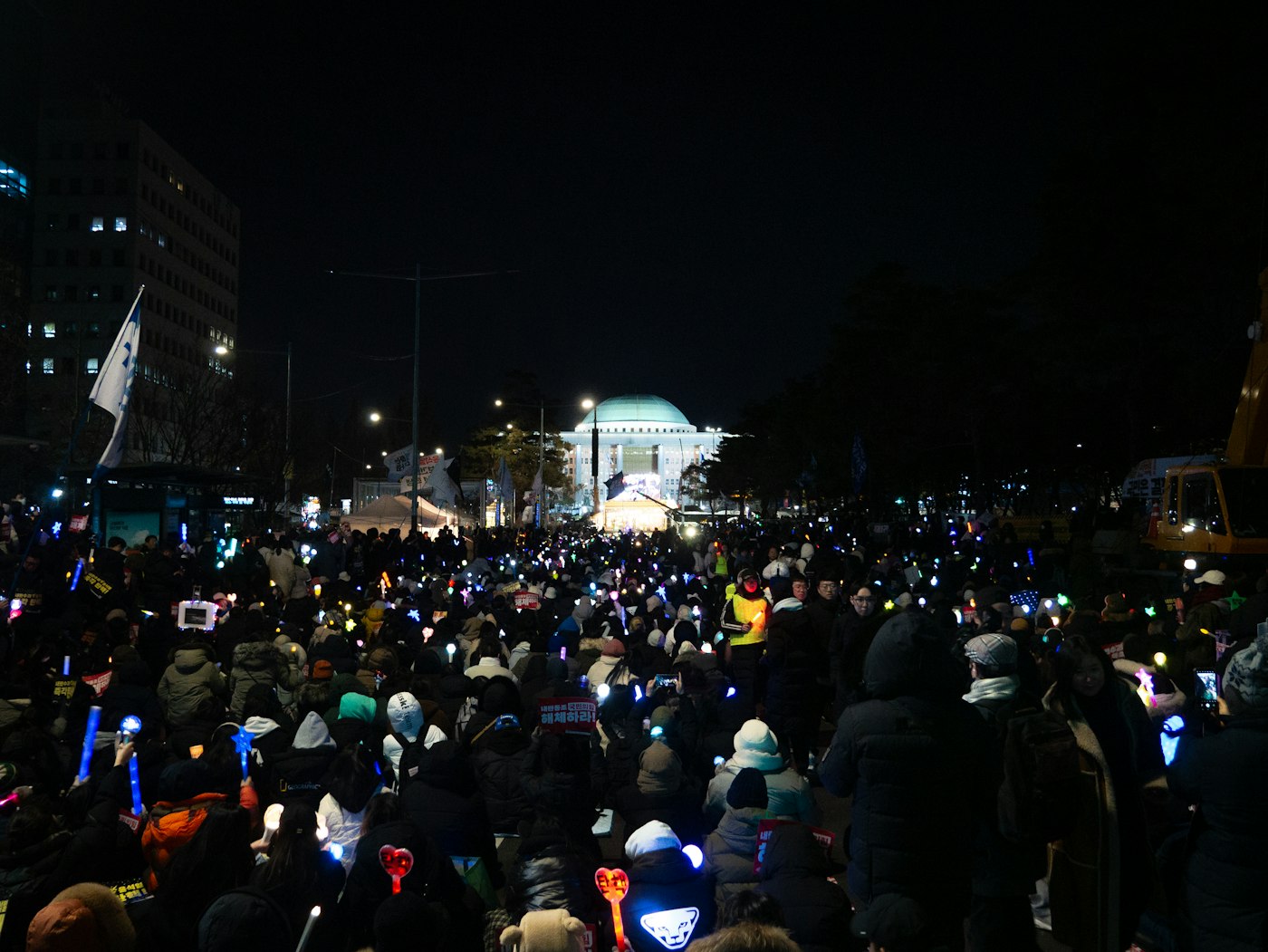
Crop the bottom half of the photograph and it could be a K-pop concert.
Thousands of lights move through the dark.
BTS.
NCT.
aespa.
NewJeans.
Girls’ Generation.
People sing, film themselves, take selfies and wave the expensive official light sticks they normally carry to concerts.
Except there is no idol onstage.
There is barely a stage.
They are standing outside the National Assembly of South Korea.
And they are not waiting for an encore.
They are waiting for an impeachment vote.
This was Seoul in December 2024.
K-pop and light sticks fire up impeachment protests in South Korea — Reuters
Only days earlier, President Yoon Suk Yeol had declared martial law.
Troops had entered the National Assembly compound.
Then young Koreans showed up carrying K-pop merchandise.
If you know only the surface version of Korea, this can look almost comically contradictory.
The country of semiconductors, K-pop and ultra-fast internet suddenly produced a phrase many younger Koreans knew mainly from history books:
martial law.
And its citizens answered partly with another product of hyper-modern Korea:
idol light sticks.
That contradiction makes much more sense once you understand how young Korean democracy actually is.
A Hong Kong Friend Once Asked Me a Very Good Question
A friend from Hong Kong once asked me something I had never really considered.
We were talking about Korean politics when he said:
“Why do so many Korean presidents end so badly?”
It sounds exaggerated.
Then you start going through the list.
South Korea’s first president, Syngman Rhee, was forced to resign after the 1960 April Revolution and spent his remaining years in exile in Hawaii. (영어-러시아어 사전 무료 온라인)
Park Chung-hee, who ruled for 18 years, was assassinated in 1979 by his own intelligence chief.
Chun Doo-hwan, the military strongman who followed, was later convicted over mutiny, the military seizure of power and corruption and received a life sentence before being pardoned.
His successor Roh Tae-woo received a 17-year prison sentence over mutiny and corruption before he too was pardoned. (코리아타임스)
Former president Roh Moo-hyun died by suicide in 2009 while a corruption investigation involving his family was underway. (코리아타임스)
Lee Myung-bak later went to prison after being convicted of bribery and embezzlement.
Park Geun-hye was impeached, removed from office by the Constitutional Court, convicted and imprisoned before eventually receiving a presidential pardon. (Reuters)
And then came Yoon Suk Yeol.
The Constitutional Court unanimously removed him from office in April 2025 over constitutional and legal violations surrounding his martial-law declaration. In February 2026, a lower court sentenced him to life imprisonment for leading an insurrection; in a separate case, South Korea’s Supreme Court upheld a seven-year prison sentence in July 2026 for obstruction and related offences. Other legal proceedings have continued. (헌법재판소)
There have, of course, been presidents who completed their terms normally.
But read the entire presidential timeline and the Hong Kong friend’s question stops sounding silly.
Exile.
Assassination.
Forced resignation.
Military coups.
Prison.
Suicide.
Impeachment.
More prison.
At times, South Korea’s presidential history reads less like a civics textbook than the season guide for an unusually violent political drama.
My First Answer Was: “Because Korean Democracy Is Young”
I thought for a moment and told my friend:
“Probably because our democracy is still young. Korea seems to be doing everything in compressed time.”
I still think that answer was partly right.
South Korea had constitutions, elections and a National Assembly long before 1987.
But the decisive institutional foundation of today’s democratic system came only after the June Democratic Uprising of 1987.
Mass demonstrations forced the government to accept direct presidential elections and a constitutional revision that expanded political rights. The current constitutional framework emerged from that transition. (국가기록포털)
Count from 1987 to 2026.
That is about 39 years.
A middle-aged human being.
There are Koreans in their fifties today who personally remember living under military-backed authoritarian government.
Older Koreans remember tear gas.
Their daughters and granddaughters may have stood outside parliament in 2024 holding an aespa light stick.
The distance between those two images is barely one generation.
Korea Did Not Only Compress Economic Development
People often describe South Korea’s economic rise as compressed development.
A devastated postwar society industrialized at extraordinary speed.
Textiles.
Steel.
Shipbuilding.
Cars.
Semiconductors.
Smartphones.
Transformations that took far longer elsewhere were squeezed into a few decades.
Sociologist Chang Kyung-sup developed the broader concept of “compressed modernity” to describe a society in which economic, political, social and cultural transformations occur in an unusually condensed period and coexist in complicated layers. (Wiley Online Library)
Democracy was compressed too.
Korea moved through authoritarian government, mass resistance, constitutional reform, direct elections, peaceful changes of government, prosecution of former dictators, presidential impeachment and repeated mass mobilization within an astonishingly short period.
So allow me a deliberately informal phrase:
compressed democracy.
It is not a claim that Korea invented a unique type of democracy.
It is a useful way to see the speed.
Several historical eras of democracy are still alive at the same time.
Someone remembers dictatorship.
Someone remembers fighting dictatorship.
Someone’s first political experience was a candlelight rally.
Someone else learned collective action in a K-pop fandom.
They all vote in the same elections.
Sometimes they occupy opposite sides of the same Seoul boulevard.
But “Young Democracy” Alone Does Not Explain the Presidential Curse
That would be too easy.
Several other structures matter.
South Korea historically developed a powerful presidency, especially under authoritarian rule.
More concentrated power creates more opportunity for both abuse and spectacular accountability.
Korean politics also has a long tradition of aggressive post-presidential investigation.
Sometimes that is genuine democratic accountability.
Sometimes critics see political revenge.
Often the argument is precisely over where one ends and the other begins.
And then there is public expectation.
Koreans can be extraordinarily distrustful of politicians while simultaneously expecting enormous amounts from them.
The presidency is not treated as something sacred that should be protected for the dignity of the state.
Modern Korean democracy increasingly contains another idea:
If a president crosses certain lines, the president can be removed.
A former president going to prison is therefore not automatically proof that democracy has failed.
Sometimes it can demonstrate something almost opposite:
even the president can go to prison.
That does not mean every prosecution is fair or politically neutral.
The argument over that question is itself part of democracy.
Was the 2024 Martial-Law Crisis a Failure of Korean Democracy or a Success?
The uncomfortable answer is:
both.
A sitting president declared martial law and sent military and police forces to the National Assembly.
That is a profound democratic failure.
When the Constitutional Court removed Yoon in April 2025, it found serious constitutional and statutory violations involving the declaration of martial law and the deployment of forces to parliament. (헌법재판소)
But something else happened that night.
Lawmakers got into parliament.
A total of 190 legislators voted to demand an end to martial law.
All 190 voted yes.
Journalists kept reporting.
Citizens gathered outside.
The military ultimately withdrew.
Parliament later impeached the president.
The Constitutional Court reviewed the case.
A new president was ultimately chosen through an election.
So the same event contains two stories.
A president tested the democratic guardrails.
And:
many of the guardrails worked.
Democracy is perhaps less like a car that never crashes than one whose brakes and airbags are supposed to work when it does.
South Korea performed a terrifyingly real crash test.
Look Next Door at Japan and Korea Becomes Stranger
Japan and South Korea are wealthy East Asian democracies sitting next to each other.
Their modern street politics, however, developed very differently.
Japan once had enormous demonstrations.
The 1960 Anpo protests against revision of the US-Japan Security Treaty became one of the largest political mobilizations in modern Japanese history. Violent clashes surrounded the Diet, and the crisis contributed to Prime Minister Kishi Nobusuke’s resignation. (Cambridge)
Student activism exploded again in the late 1960s.
But radicalization, factional violence and police suppression helped destroy the broader legitimacy of militant student politics by the early 1970s. (Cambridge)
That does not mean Japanese people stopped protesting.
The post-Fukushima antinuclear movement mobilized large crowds.
In 2015, the youth organization SEALDs drew major attention for opposing the Abe government’s security legislation, becoming one of the most visible university-centered political movements in decades. (Cambridge)
The better distinction is this:
mass street protest became much less central to ordinary Japanese political life.
In South Korea, it never completely did.
Koreans vote.
They petition.
They argue online.
They organize through political parties.
But when the crisis feels large enough, a sentence remains remarkably normal:
“Let’s go to Gwanghwamun.”
The square is still part of the political vocabulary.
China Provides the Opposite Comparison
From abroad, China can look like a country without protest.
That is also wrong.
Chinese citizens protest surprisingly often.
Freedom House’s China Dissent Monitor documented 5,343 dissent events in 2025 alone, involving workers demanding unpaid wages, homebuyers angry over unfinished housing, rural residents involved in land disputes, parents, students and small-business owners. It recorded another 846 events in the second quarter of 2026. (Freedom House)
China does not lack protest.
The crucial difference appears when protest becomes national politics.
Organized activity aimed directly at Communist Party rule, central political leadership or democratic change faces an entirely different level of risk.
Freedom House gives China just 1 out of 4 for freedom of assembly. Its reporting describes extensive surveillance, real-name internet systems, facial recognition, censorship and punishment for unauthorized political expression. (Freedom House)
In one 2025 analysis, two-thirds of nearly 3,000 Douyin posts about protests that researchers tracked were later deleted. (Freedom House)
So the difference is not:
Chinese people obey; Koreans rebel.
That is cultural caricature.
The difference is partly institutional.
In South Korea, going into the street is a protected political right.
In China, depending on what exactly you are protesting and whom you are challenging, the personal risk can be radically different.
Put Japan, China and Korea Side by Side
The comparison is imperfect, but useful.
Japan: has a dramatic history of mass protest, but street mobilization became relatively less central as postwar institutional politics stabilized.
China: has plenty of localized protest, but the state strongly restricts its ability to become a national challenge to political power.
South Korea: developed elections, courts and competitive party politics while keeping large-scale street mobilization as a legitimate political pressure mechanism.
That last combination is important.
Korea’s distinctive feature is not simply that Koreans demonstrate.
It is that street pressure repeatedly connects back into institutions.
The April Revolution of 1960 forced Rhee’s resignation.
The June Uprising of 1987 produced constitutional change and direct presidential elections.
The 2016–17 candlelight demonstrations ran alongside parliamentary impeachment and Constitutional Court review.
The 2024–25 demonstrations again existed beside impeachment procedures and judicial review.
The crowd does not itself become law.
But there are channels through which pressure from the street can enter the constitutional system.
That changes everything.
The Really Strange Part: This Noisy Democracy Scores Pretty Well
If you consume Korean politics entirely through headlines, the country can look permanently five minutes from collapse.
A president is impeached.
Politicians scream at each other.
Prosecutors investigate politicians.
Political YouTubers describe opponents as existential threats.
Mass rallies occupy central Seoul.
This is not the aesthetic most people associate with a calm, mature democracy.
And yet the international data tells another story.
Freedom House’s Freedom in the World 2026 gives South Korea 83 out of 100 and classifies it as Free. It points to regular transfers of power, robust political pluralism and strong protections for assembly, while also noting serious weaknesses and continuing controversies. (Freedom House)
Now restrict the comparison to countries with more than roughly 50 million people.
Japan: 96.
Germany: 95.
United Kingdom: 92.
France: 89.
Italy: 87.
South Korea: 83.
United States: 81. (Freedom House)
One index cannot settle arguments about democracy.
But the scale matters.
Korea is not a small Scandinavian country with a population of five million and unusually easy political coordination.
It has more than 51 million people.
It has extreme ideological polarization.
It lives beside North Korea.
Its current democratic constitutional order is not yet forty years old.
And it nevertheless belongs to the upper tier of the world’s large democratic states by this measure.
That is a much more interesting story than saying either:
“Korean politics is a mess.”
or:
“Korean democracy is amazing.”
Both are too easy.
Maybe the Terrible Presidential Endings Are Part of the Compression
You can tell Korea’s presidential history in two completely opposite ways.
Version one:
The political system is immature, so presidents keep ending up in disaster.
Version two:
The political system is strong enough to punish even former presidents.
Both contain some truth.
Jailing former military dictators was part of reckoning with authoritarian rule.
Investigations of civilian presidents have involved genuine questions of corruption but also repeated accusations of political revenge.
Removing Park Geun-hye and Yoon Suk Yeol demonstrated that presidents are constitutionally removable.
The fact that Korea needed to remove two presidents within less than a decade is hardly evidence of perfect political stability.
So a more useful sentence may be:
Korean democracy is noisy partly because it works, and noisy partly because it is still unfinished.
Those things can coexist.
Korea is very good at coexistence between things that theoretically should belong to different eras.
That is compressed modernity again.
And Then the Latest Generation Brought K-pop Light Sticks
Back to December 2024.
A K-pop light stick was not merely a prettier candle.
Fans arrived with an entire culture of collective action.
When a song is released, fans stream it at coordinated times.
They vote.
Fund advertisements.
Translate information.
Organize hashtags.
Buy albums collectively.
Share ticket information.
Coordinate fandom projects across countries.
Korean fandom even has the word chonggong (총공) — originally short for something like “total attack,” now commonly used for a coordinated mass action by fans.
Streaming chonggong.
Voting chonggong.
Hashtag chonggong.
From the perspective of political organization, that is fascinating.
These are people who already know how to synchronize the behavior of thousands of strangers through digital networks.
No headquarters required.
K-pop Fandom Is Not a School of Democracy. It Is a School of Coordination.
That distinction matters.
K-pop fans are not one political bloc.
They can be conservative, progressive, centrist, apolitical or simply uninterested.
Fandom itself can also be tribal, aggressive and highly conformist.
The same coordination skills can be used for harassment as easily as activism.
The technology is not democratic by nature.
What changed in 2024 was its destination.
A tool normally used to raise a song on a chart moved into civic space.
A light stick designed to make a concert beautiful became a political signal.
A chant format designed for idol names carried impeachment slogans.
The infrastructure stayed familiar.
The object of devotion changed.
This Helps Explain the Young Women
One of the most striking features of the pro-impeachment demonstrations was the presence of younger women.
Location-based population data for the National Assembly area on December 14 showed women in their twenties as the largest single age-and-gender group, with women overall making up a clear majority of the estimated crowd.
This should not be reduced to:
“K-pop fans are female.”
Something more interesting was happening.
A generation that already knew how to organize through culture entered a political space that had suddenly adopted its language.
They did not have to become 1980s-style student activists first.
They could arrive as themselves.
With an aespa light stick.
Even the Flags Became Memes
Traditional protest organizations still appeared.
So did labor unions and activist groups.
But protesters also carried flags representing organizations that did not really exist.
Associations of office workers with forward-head posture.
Ridiculous food societies.
Cat lovers.
Various intentionally meaningless clubs.
They were jokes.
They were also politically meaningful jokes.
Older mass politics often said:
“I am here as a member of this organization.”
The meme flag says:
“I am an ordinary idiot with a bad neck and a cat, and I still have political rights.”
You do not have to transform yourself into a Professional Political Person to enter the square.
This may be one of the most democratic things about the new aesthetic.
How Did a Girls’ Generation Song Become Protest Music?
One of the songs repeatedly heard in Korean protests has been Girls’ Generation’s “Into the New World.”
Released in 2007.
An idol debut song.
Not a revolutionary anthem.
But the song took on another life after students at Ewha Womans University sang it during protests in 2016.
It then appeared repeatedly in youth and women’s demonstrations and returned during the 2024 political crisis.
Nobody officially designated it a democracy song.
There was no Ministry of Protest Music.
People kept using it until its social meaning expanded.
The songwriter creates the first life of a song.
Sometimes the audience creates the second.
Of Course, There Was Another Square
A neat story would stop here.
Young democratic citizens.
Beautiful lights.
K-pop.
Impeachment.
That would also be misleading.
Large demonstrations opposed Yoon’s impeachment too.
They attracted substantial numbers of conservative citizens, religious groups and older participants.
Their visual language looked different.
Korean national flags.
American flags.
Religious messages.
Political YouTube culture.
On one side of central Seoul, young people held idol light sticks.
On another, older participants held Taegeukgi.
Both groups claimed to be defending the Republic of Korea.
That is why Korean polarization cannot be reduced simply to disagreement over tax rates or one policy.
Different generations increasingly inhabit different media ecosystems and cultural worlds.
Politics is partly a conflict between those worlds.
Japan Moved Much of Protest Into Institutional Politics. China Restricts Its Political Expansion. Korea Still Lives Between the Two.
That is deliberately simplified, but it captures something.
South Korea has powerful institutions.
Elections matter enormously.
Courts matter.
The National Assembly matters.
But Koreans have not abandoned another belief:
If the institutions stop listening, you can still fill the square.
That belief can be dangerous.
A large crowd is not automatically correct.
Popularity is not constitutionality.
A rally cannot replace a court.
A light stick cannot replace a ballot.
But the opposite danger exists too.
A democracy made only of institutions, with citizens who no longer believe participation matters, can become hollow.
South Korea is still negotiating the distance between those two risks.
Very loudly.
A 39-Year-Old Democracy Is Doing Surprisingly Well — and Still Breaking Things
Using 1987 as the institutional turning point, contemporary South Korean democracy is roughly 39 years old.
Too old to call a child.
Very young compared with many established democracies.
Within those decades, Korea has seen peaceful transfers of power between rival parties, prosecuted former dictators, removed presidents through constitutional procedures, and developed a highly competitive media and civil society.
It has also experienced intense polarization, political retaliation controversies, corruption scandals and, astonishingly, an attempted martial-law intervention in 2024.
It is not a finished product.
It is a remarkably functional beta version that occasionally produces terrifying bugs.
So Today I Would Give My Hong Kong Friend a Different Answer
“Why do Korean presidents end so badly?”
Years ago, I said:
“Because our democracy is young.”
Today I would say:
“Because Korea has practiced an enormous amount of democracy in a very short time.”
It remembers dictatorship.
It remembers military coups.
It fought for direct elections.
It prosecuted former dictators.
It learned peaceful transfers of power.
It invented internet-age candlelight protest.
It impeached a president.
Then, less than a decade later, it impeached another.
Much of this happened within roughly forty years.
South Korea did not only compress industrialization.
It compressed democratic trial and error.
That helps explain the noise.
The dramatic endings.
And perhaps why taking politics into the street still does not feel obsolete here.
Now Look at the Light Stick One More Time
Seoul.
Winter.
The National Assembly glows in the background.
Teenagers are there.
People in their twenties.
Parents.
Union members.
People who have never attended a political rally in their lives.
Different fandoms hold different lights.
On an ordinary weekend, some of these people might be fighting online about album sales.
Tonight their lights move in roughly the same direction.
Forty years earlier, this kind of confrontation might have smelled of tear gas.
Twenty years earlier, there would have been candles inside paper cups.
A decade ago, LED candles and smartphones.
Now:
K-pop merchandise.
Seen superficially, democracy looks as though it has become less serious.
There is another interpretation.
You no longer have to look like a hero to participate in it.
You do not have to be a professional activist.
You do not need a political science degree.
You are allowed to be a fan.
A tired office worker.
Someone mostly interested in cats.
Those people are citizens too.
Freedom House restored South Korea’s freedom-of-assembly score to the maximum 4 out of 4 in its 2026 report, noting that demonstrations generally proceeded without undue restriction after the martial-law crisis. (Freedom House)
South Korea is not the world’s quietest democracy.
It is not the oldest.
It is not necessarily the best.
But there is something extraordinary about a country of more than 50 million people, technically still living under an armistice with North Korea, whose parents’ generation lived under military dictatorship, now using elections, courts, parliament — and occasionally K-pop light sticks — to fight over the limits of presidential power.
So when you see those videos, do not stop at:
“Koreans even make protests look like K-pop concerts.”
Behind those lights are the April Revolution.
Gwangju.
The candlelight demonstrations.
Two presidential removals.
And one persistent Korean political instinct:
An election does not end the citizen’s job.
Democracy in South Korea is still being built.
Sometimes loudly.
Sometimes dangerously.
And lately,
with much better lighting.